Learning Journey at UWC - Part III

Updated: Apr 8, 2020
Today (March 2, 2020) marks my 15th day at UWC Pearson College. This blog post will discuss a few updates on how my week has been, personal insights and lingering questions. Additionally, I was fortunate to have a meeting with one of the senior faculty visiting me and

meeting with the UWC staff. We had a deep conversation reading student personality types and the nature in teaching a global classroom. These points of discussion lead to me the realization that extroverted students are a better fit for the teaching format at UWC.
I chose to list significant events that happened during the week and briefly discuss their significance to me as a teacher.
1. Global Affairs Speaker Series
On Thursday, I attended a Global Affairs speaker series held weekly. On Feb 27th the topic of discussion was “The Paleolithic origins of art & language”. I found this presentation to be highly interesting and expanded my horizons with regards to the origin of “communication” and “language”.

We learned that early humans used cave drawings and hand signs to communicate and this was a way of communication that lasted for over ten thousand years. This form of communication gave early humans a hunting and cooperative advantage over other species. The speaker detailed the cognitive evolution of humans through their remaining artifacts. I was very impressed by this work and thought to myself that communication has taken thousands of years to evolve to the point we take for granted now. I learned that the nature of communication is deeply linked by the people who use the language to get through their day.
2. Creativity Activity Service (CAS) Involvement
IB’s Creativity Activity Service (CAS) is a mandatory component of the IB Program. This CAS activity normally takes place every Monday, Wednesday and Friday for 2.5 hours in the afternoon. During these CAS blocks, students can engage in various initiatives, demonstrate perseverance and develop various skills such as collaboration, problem-solving and decision making.
“CAS allows students to enhance their personal and interpersonal development through practical, hands-on experience, rather than solely focusing on education inside the classroom. ... In order for student development to occur, CAS should always involve Real, purposeful activities, with significant outcomes.” (Young, 2002).
Research suggests experiential learning benefits student learning. The act of physically engaging the body and mind in the activity helps students integrate concepts that understand at a deeper level. The definition of the classroom can be expanded beyond the wall of the room itself to include any place where learning occurs. Often time the best way to learn about the subject you are studying is to experience it first hand. In this way, students understand more about the context and significance of the subject being studied.


Specifically, at Pearson College, students have their choice of sailing, scuba diving, kayaking, mindfulness, yoga and pottery classes among others. Students partake in different CAS events throughout the week in order to add to the diversity of experiences gained at UWC. My involvement in the CAS led me to instruct students on how to sail. I found this activity to be particularly rewarding as sailing integrates both the body and mind in the act of doing the activity. After the sailing classes on Monday, Wednesday and Friday, I started a discussion around the physics behind sailing. Using sailing as a real-world example I connected the academic concepts of forces and work to our actions out on the water. This conversation helped students internalize these concepts in terms that they could intuitively understand.
3. Designing Curriculum on Race Rocks Island
“Experiential learning ... is initiated in the works of an interaction between the learner and his or her environment” (Bauerle, & Park, 2012). Leveraging this learning premise, I help design a curriculum with an emphasis on sustainability. Throughout the development of this curriculum, several different learning approaches were considered. What the faculty and I decided on is that students will spend a weekend at Race Rocks island. This trip includes several considerations to maximize the sustainability of living on the island.
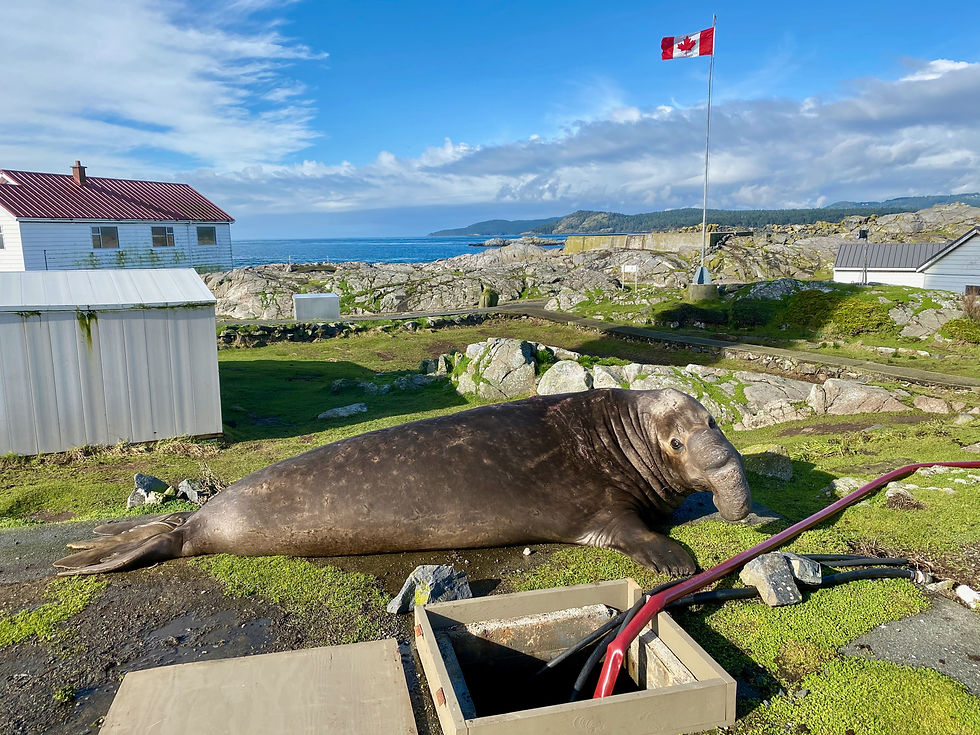
For example, students can leverage solar energy to meet their electricity needs for the weekend. Also, through the process of desalination students can extract fresh water. The faculty and I discussed some of the specific details to get drinkable water. This trip will allow students to document the number and type of species Native to the location. The faculty and I discussed the risks associated with the increasing oil export through British Columbia and its related environmental strain on local ecosystems. Through studying the population of various animals on the island, students will generate useful data needed to help understand the population changes in the future.


This hands-on activity will help students solidify abstract developmental concepts into more concrete understanding. Hands-on experiences aid students “learning as the transformation of knowledge from experiences” (Bauerle, & Park, 2012). Students will benefit from this learning experience as being both physically and mentally present is far more impactful than learning from a textbook.

Lastly, the Native elders were consulted with regards to the curriculum design and key learnings takeaways. This process shows both respects for the native culture but acknowledges the accumulated native knowledge which western academic thinking may have overlooked.
4. My Role as running Tutorials and Teaching
One of the ways I have found to give back to UWC is through the act of holding tutoring sessions in the subjects of both math and chemistry. This role has taught me that students are constantly striving to reach their potential. With this attitude comes a multitude of questions requiring me to explain misunderstood concepts. I will be teaching math next week. Also, I have found the pace of the academic studies at UWC does not allow for more traditional hands-on demonstrations of concepts. Typically, the most time-efficient method of showing students concepts is chosen in an effort to learn a larger volume of material.


Personal Insights
My time at UWC has shown me that the emphasis on sustainability takes many different forms. The use of natural light in classrooms reduces the electrical demand of the school. Also, the school’s use of compost helps reduce the amount of organic waste disposed of. However, this solution does not treat the sewage generated by the school. Moreover, the quality of student interactions has shown me that students are learning life long lessons. “all experiences are not equally educative with some being more engaging from cognitive, emotional, and physical standpoints' (Bauerle, & Park, 2012). The quality experience at UWC helps shape the character of the students which informs their future actions as global citizens.
One lingering question that I have discovered is at what scale are actions considered sustainable vs unsustainable? These questions can be illustrated by building an imaginary cabin in the woods. On a small scale, the wood used to build and heat the cabin can be considered sustainable. However, If all 7.8 billion people in the world attempted to live this lifestyle we would quickly find out this lifestyle is unsustainable. Thus, at what scale do actions go from sustainable to unsustainable? Ultimately, this question is deeply linked to the world’s capacity to sustain human life.
Furthermore, I am curious about what community service actions the UWC students engage in during CAS. There seems to be more orientation for sports “activities” rather than community service or creativity. Perhaps the “One World” (see blog 2 for more information on One world play) performed by UWC students is part of the community service initiative. However, I think there should be more actions other than the play that give back to the community.

Note: All pictures are taken by my iphone or Nikon DSLR Camera. Do not copy any images. I have all rights and priviledges.
References
Bauerle, T. L., & Park, T. D. (2012). Experiential learning enhances student knowledge retention in the plant sciences. HortTechnology, 22(5), 715-718.
Young, M. R. (2002). Experiential learning= hands-on+ minds-on. Marketing Education Review, 12(1), 43-51


Comments